Hard to understand unfamiliar code
Jumping between files, grepping for functions, and tracing call chains eats hours every week.
Search, explore, and query your entire codebase and documentation like Google. No more digging through files or outdated docs.
Every team faces these challenges. Most just accept them as “part of the job.” They shouldn’t be.
Jumping between files, grepping for functions, and tracing call chains eats hours every week.
The docs say one thing. The code does another. Nobody knows which one to trust.
Where is the payment flow? Who calls this function? Simple questions, painful answers.
New developers spend weeks ramping up instead of shipping. Context lives in people's heads.
Tracely360 is a code intelligence and codebase search platform that builds a graph of your services, dependencies, and flows.
It lets developers understand large codebases, speed up developer onboarding, and debug issues using natural-language queries instead of manual code spelunking.
Teams can start with the free open-source tracely360 Lite engine, then expand into the full Tracely360 platform for broader codebase search and collaboration.
Give new team members an instant map of your codebase — services, dependencies, and how everything connects.
“Show me all the API endpoints and which services they call” — answered in seconds, not hours of code spelunking.
Stop reverse-engineering undocumented code. Query the structure and trace logic across files with plain language.
“How does the user authentication flow work?” — get a structured answer with linked files and line references.
Search your entire codebase and documentation like Google. No more grep chains or guesswork.
“Where is payment logic implemented?” — instantly see every file, function, and connection involved.
Point Tracely360 at your repository or upload your files. Supports 25+ languages out of the box.
Tracely360 parses your code, maps relationships, and builds a searchable intelligence layer automatically.
Ask questions in plain language. Get structured answers with file references, dependencies, and code context.
No more grep. No more guesswork. Click a query below and watch it work.
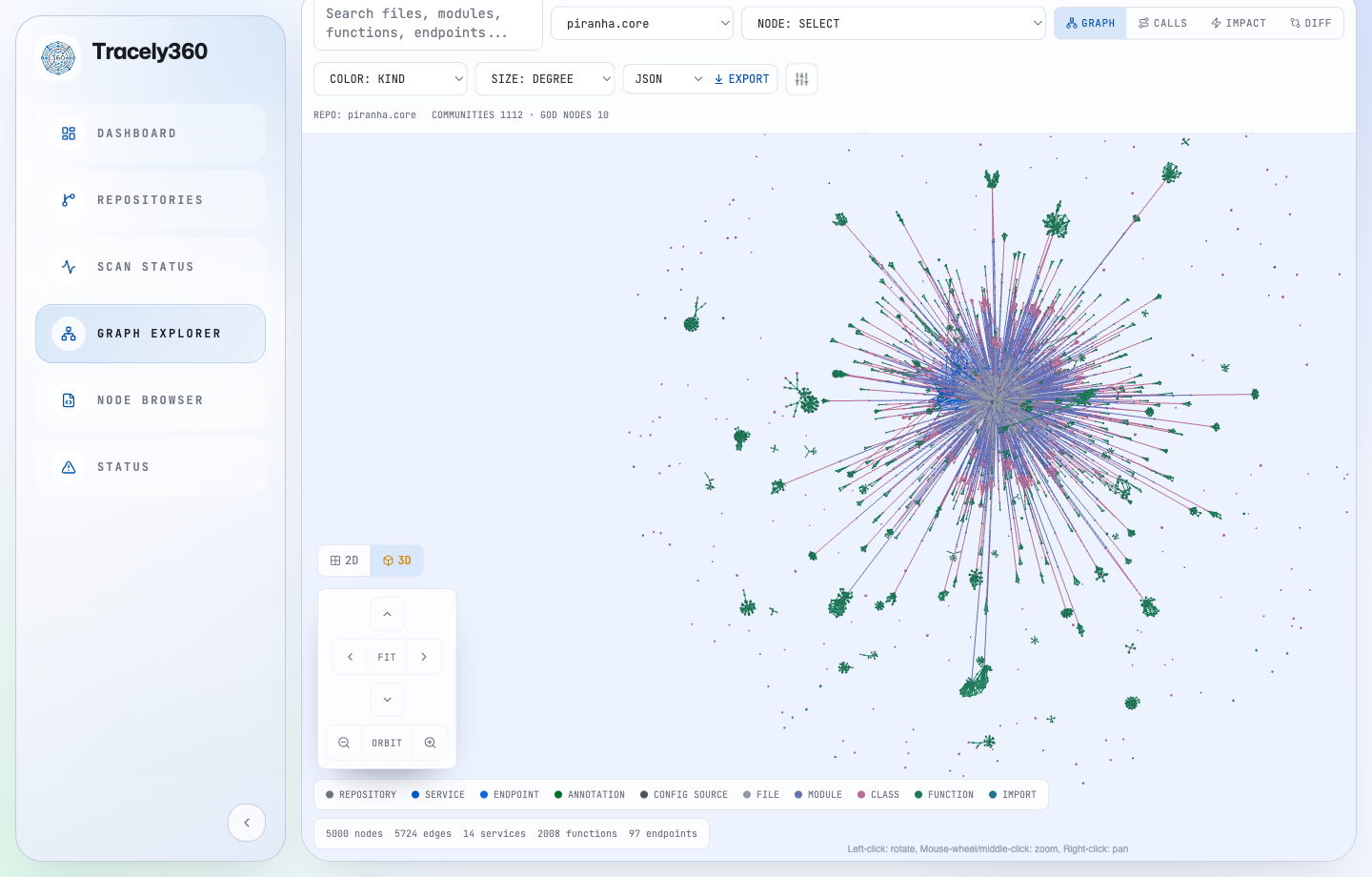
Navigate relationships, drill into details, and understand structure at a glance.
Visually explore how your codebase connects — services, dependencies, and relationships in an interactive 3D view.
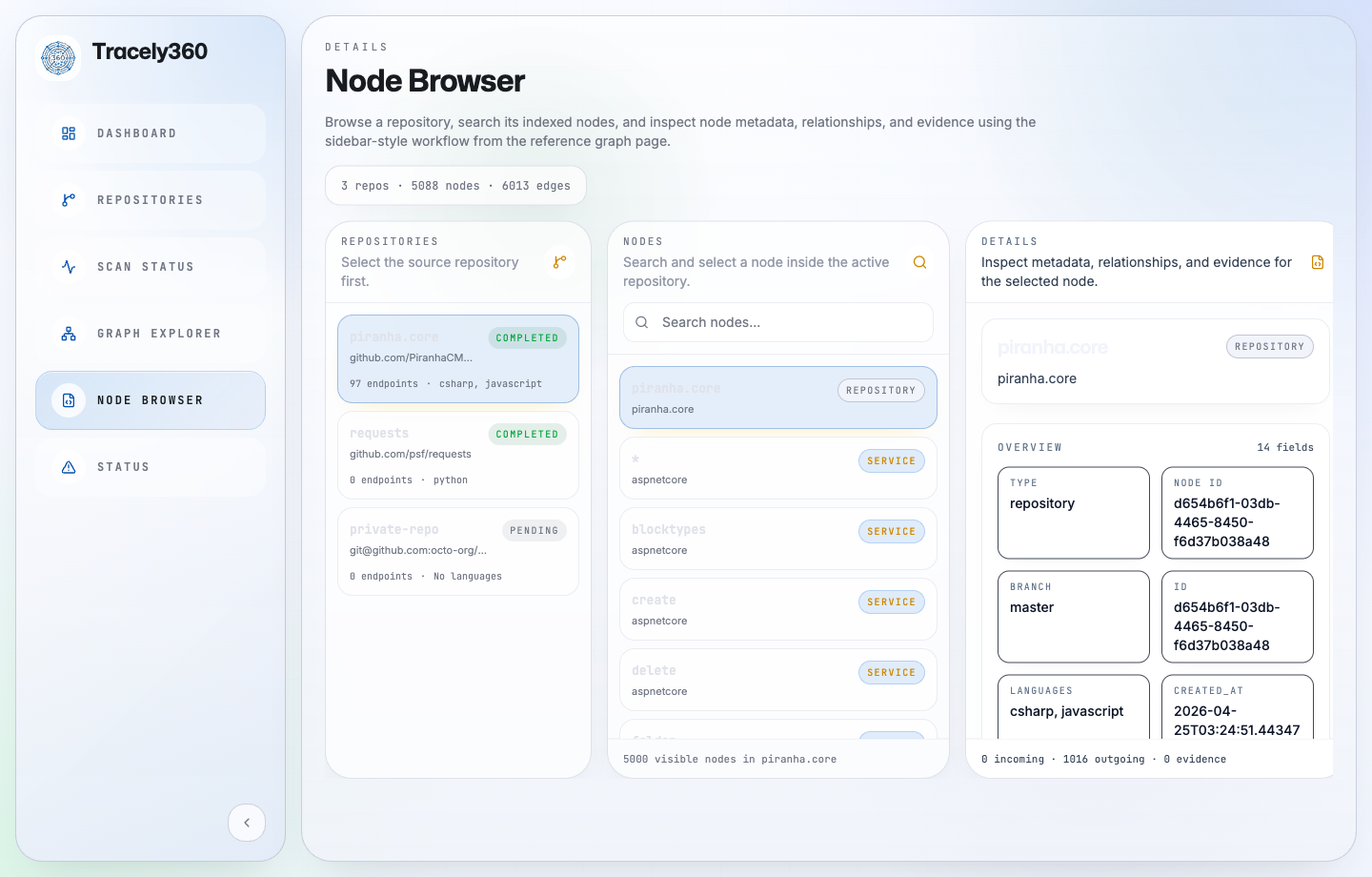
Drill into any file, function, or service. See metadata, relationships, and evidence — all in one place.
Explore your codebase in seconds. Join developers who ship faster.
tracely360 Lite is a local knowledge graph engine for AI coding assistants. It runs locally, supports 25+ languages, and helps teams reduce token usage while understanding code faster.
Deterministic extraction runs locally with zero LLM calls and zero API cost.
Works with Claude Code, Codex, Cursor, VS Code Copilot, and more.
Graph queries use ~1.7k tokens versus ~123k reading raw files.
Answers to the questions developers ask when evaluating codebase search and code intelligence tools.
Tracely360 builds a code intelligence layer over your repository so you can search architecture, dependencies, and flows in plain language. Instead of tracing logic manually across dozens of files, developers get structured answers with file references and relationships.
New developers can query the codebase for services, endpoints, dependencies, and ownership patterns instead of relying on tribal knowledge. That shortens ramp-up time and gives teams a faster path from first day to first useful change.
Grep finds text matches. Tracely360 builds a graph of services, functions, files, and relationships so developers can ask how the system works, not just where a string appears.
Yes. Tracely360 is designed for large monoliths, service-oriented systems, and mixed environments where code and documentation live in different places. It helps teams see cross-service flows as well as local module structure.
Teams can start with the Tracely360 Lite engine locally, then evaluate the full platform for broader codebase search and onboarding workflows. If you need deployment details, Tracely360 can be discussed around your environment, security, and access requirements.